
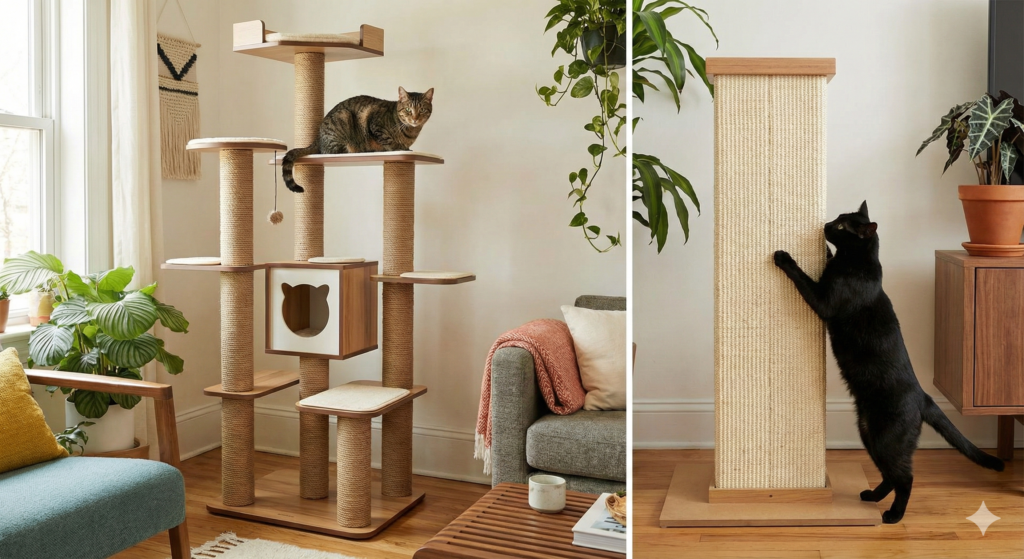
Cat Tree vs. Cat Scratching Post: Which Is Better for Indoor Cats?
Quick answer: If you can only buy one, choose the option that matches how your cat scratches (vertical vs. horizontal) and how much “vertical space” your home allows. In many homes, the best setup is both: one stable scratching post near the “problem area” plus a cat tree that gives perches + an extra scratching surface.
At a Glance: Cat Tree vs. Scratching Post
| Feature | Cat Tree | Scratching Post | Best For |
|---|---|---|---|
| Primary purpose | Climbing, perching, hiding, plus (often) scratching surfaces | Dedicated scratching + stretching outlet | Choose based on your cat’s biggest need |
| Space | Takes more floor space, adds vertical territory | Can be very compact | Small apartments usually start with a post |
| Scratching quality | Depends on model (some have short/weak scratch zones) | Usually stronger for “full-body” scratching when tall + stable | Heavy scratchers benefit from a strong post |
| Multi-cat homes | Great: multiple levels reduce crowding and create safe perches | Useful, but may cause “line-up conflicts” if there’s only one | Multi-cat: cat tree + multiple scratchers |
| Budget | Typically higher cost | Wide range; good options at low cost | Start with a quality post if budget is tight |
Tip: Your cat doesn’t care about “cute.” They care about stability, texture, and whether they can get a satisfying stretch.
Why Cats Scratch (So You Can Pick the Right Option)
Scratching is normal cat behavior. It helps cats:
- Maintain claws by removing worn outer layers (you often see claw sheaths nearby).
- Stretch the muscles in the shoulders, legs, and spine—especially after naps.
- Communicate/mark territory through both visible marks and scent from glands in the paws.
If your cat suddenly starts scratching “way more than usual,” seems stressed, or is damaging skin, talk with a veterinarian—sudden behavior changes can have an underlying trigger.
What a Cat Tree Is Best At
A cat tree (also called a cat condo or cat tower) is basically a vertical “cat playground.” The best ones provide:
- Perches (cats love observing from above)
- Multiple levels to move up/down without jumping off furniture
- Hideouts for quiet time
- Built-in scratching zones (often sisal-wrapped posts)
Buy a cat tree if… your indoor cat is bored, climbs curtains, crowds countertops, or you have more than one cat and need extra “vertical territory.” A good tree can reduce household tension simply by giving cats more choices of where to be.
What a Scratching Post Is Best At
A scratching post is the “specialist.” If your main goal is to stop couch damage, a post is often the fastest win—if you choose the right one.
What makes a post irresistible:
- Tall enough for a full stretch (many cats prefer stretching upward).
- Stable (no wobble—wobble kills interest fast).
- Textured material your cat likes (sisal, cardboard, carpet alternatives).
Buy a scratching post if… your cat already scratches vertical surfaces (sofas, door frames), you’re short on space, or you want the most “scratching value” per dollar.
How to Choose: A Simple Decision Flow
- Watch your cat’s style: Do they scratch up (vertical) or out (horizontal)? Match that first.
- Pick stability over looks: Heavy base, thick post, no tipping.
- Choose texture: If your cat attacks rugs, try a horizontal cardboard pad. If they shred couches, try sisal.
- If you have multiple cats: plan for multiple scratching stations (not just one).
- If you can afford only one item: choose a top-quality scratching post first, then add a cat tree later.
Placement: The #1 Reason Cats Ignore New Scratchers
Placement can matter more than the product. Start here:
- Put the post near the current “crime scene” (the couch corner your cat loves).
- Add one near sleeping areas (many cats scratch after waking up).
- Use high-traffic zones (cats like to mark where the action is).
For a cat tree, place it near a window if possible. “Cat TV” (birds, people, movement) increases daily use.
How to Get Your Cat to Use It (Without Drama)
- Reward the right choice: Treats, praise, or play immediately after your cat uses the scratcher.
- Make the couch less appealing: Temporary protection (like a cover) while your cat forms the new habit.
- Refresh the surface: Replace worn sisal or add a new cardboard pad when it gets “dead.”
Reminder: Scratching is normal. The goal is redirecting it to the right object—not “stopping scratching.”
Common Buying Mistakes (That Waste Money)
- Buying a post that’s too short for a satisfying stretch.
- Choosing something that wobbles or tips.
- Hiding the scratcher in a corner “out of the way.”
- Getting only one scratcher for a multi-cat home.
Conclusion: What Most Indoor Cats Need
If your priority is saving furniture, start with a tall, sturdy scratching post placed in the exact spots your cat already scratches. If your priority is enrichment (especially for energetic cats or multi-cat homes), add a stable cat tree with usable scratching surfaces and good perches.
Best-case setup: 1 cat tree + 2 scratchers (one vertical, one horizontal). It sounds like “more stuff,” but it’s often the simplest way to keep cats happy—and couches intact.